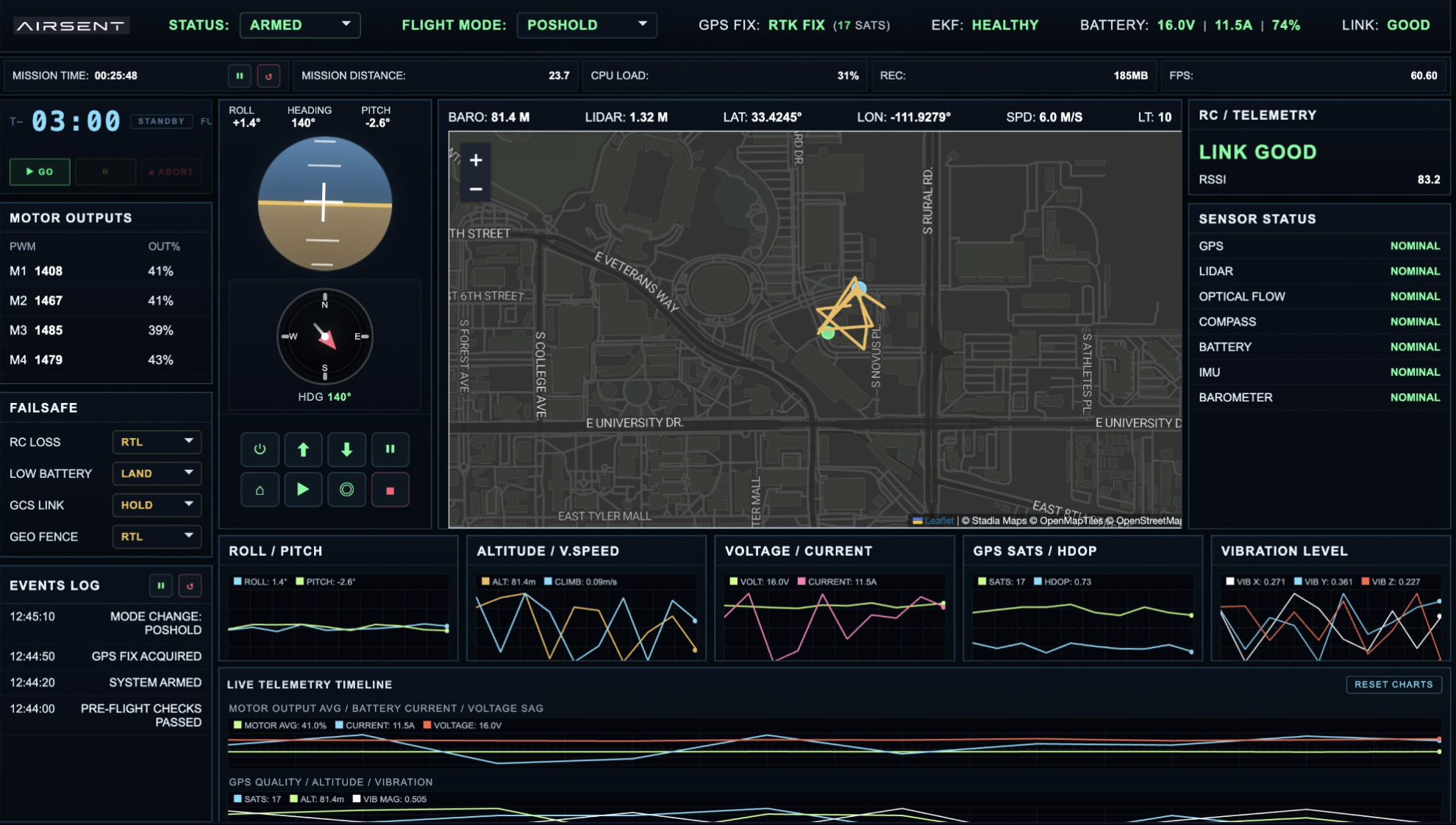
Airsent is developing a precision autonomous drone landing platform centered on a smart landing pad and non-camera sensing. Instead of relying on vision-based targeting, the system is designed to guide the drone into a controlled, repeatable, and reliable touchdown using a dedicated landing infrastructure layer.
Airsent is not trying to be another vision-based drone landing system. The core product is a camera-free precision landing architecture built around a dedicated landing pad. That matters because final approach reliability should not depend on lighting conditions, visual ambiguity, or complex image processing as the main determinant of touchdown.
A pad-centered system makes the landing environment more controlled and more repeatable than a fully open-ended visual search problem.
The landing pad is not an accessory. It is a core part of the product and creates a defensible operating model for precision drone delivery.
Instead of solving every landing environment at once, Airsent focuses on reliable landing where the system can define the final interaction.
Airsent combines autonomous flight, non-camera sensing, and a smart landing pad into one integrated platform. The drone does not simply fly to a location — it completes the mission through coordinated interaction with landing infrastructure.
The product is built around one question: how does a drone complete the last and most critical phase of the mission with higher confidence? Airsent answers that by turning the landing pad into an active part of the system.
The drone performs autonomous flight to the destination area and prepares for final landing mode.
The vehicle moves from general navigation into a dedicated final-approach logic tied to the landing system.
The landing pad becomes the reference environment for controlled touchdown, rather than relying on open-ended vision-based interpretation.
Non-camera sensing and control logic tighten the descent and correct the landing path in real time.
A controlled, pad-centered landing model can make drone delivery more practical, safer, and easier to standardize for real deployments.
The product can evolve into a delivery ecosystem where portable or fixed landing pads define where drones can complete missions cleanly and reliably.
The real bottleneck in autonomous delivery is often the last phase of touchdown. Airsent is designed specifically around solving that endgame.
A camera-free precision landing platform can support delivery environments where consistency, repeatability, and controlled touchdown matter most.
A dedicated landing system can make recurring drone deliveries more operationally predictable.
Portable or designated home landing surfaces could become the endpoint for future autonomous deliveries.
Controlled landing points are easier to standardize across repeat-use environments like campuses and facilities.
Reliable touchdown on prepared landing infrastructure can support rapid-response supply delivery scenarios.
The focus is to move from prototype-level autonomy toward a validated camera-free precision landing system centered around a deployable pad solution.
Build the initial autonomous drone platform and integrate the core landing pad concept into the mission architecture.
Demonstrate repeatable touchdown using the landing pad and non-camera sensing as the core final-approach workflow.
Expand from prototype landing success into a broader precision delivery platform built around landing infrastructure.
Airsent is building a smarter way for drones to complete the mission — by landing on purpose, not just arriving nearby.